Posted by Croma Campus
Filed in Technology 32 views

Every modern company relies on data to make smart decisions. Business Analysis is an area that connects the complicated technology with the practical problems of the companies, providing a strategy for development. If you are just starting your career, these techniques will make you unique in the world of corporations.
You need a good background to understand them, and you may find a helpful solution by taking part in a well-organised Business Analysis Course. Below, you will learn about the most useful analytical systems every professional should be aware of.
Business analysis means finding business needs and solving corporate problems. Solutions to these problems will include software development, improved processes, or even strategies. The analysts collect project requirements, analyse the data, and assist in decision-making by the management.
Failure to perform proper business analysis may result in creating unnecessary features by the developers, which may not be needed by the organisation at all. It leads to wastage of time, money, and the effort of employees. Understanding this fundamental process forms an essential part of the Business Analysis Course.
SWOT stands for Strengths, Weaknesses, Opportunities, and Threats. It assists in analysing the internal capabilities of the firm and the external market environment. SWOT should be used early in the development of a project. The SWOT analysis provides an overview of the strengths and weaknesses of the company.
Strengths: These are the internal attributes that offer the firm competitive advantages over its competitors.
Weaknesses: They are the internal issues that need improvement for the firm to remain competitive.
Opportunities: These refer to external environmental changes that could benefit the firm.
Threats: They are external issues that may pose problems for the business model.
A local shop wants to launch a mobile app for home delivery. The analyst uses SWOT to check if they are ready before spending money.
|
Category |
Internal Factors |
External Factors |
|
Positive |
Strengths: Big local customer base, good stock control. |
Opportunities: High local demand for fast home delivery. |
|
Negative |
Weaknesses: No tech team, very low marketing budget. |
Threats: Large online apps already control the market. |
All projects face constraints of time, money, and people. With the MoSCoW technique, analysts classify all the activities involved in the project into four clear categories. This way, the IT team prioritizes building the key functionalities of the project. It is very simple to learn this technique using online resources. An effective Business Analytics Online Course will help you learn this matrix for large-scale projects.
Must Have: Key functionalities necessary for the launch of the project.
Should Have: Important features that add high value but are not vital.
Could Have: Minor features that can be included if there is more time.
Won't Have: Features with low priority for the moment.
Companies do not exist alone, the external environment keeps changing the way they operate. The PESTLE analysis assists you in recognising these major changes in order to protect the project from any risk. It provides a wide overview of the whole market.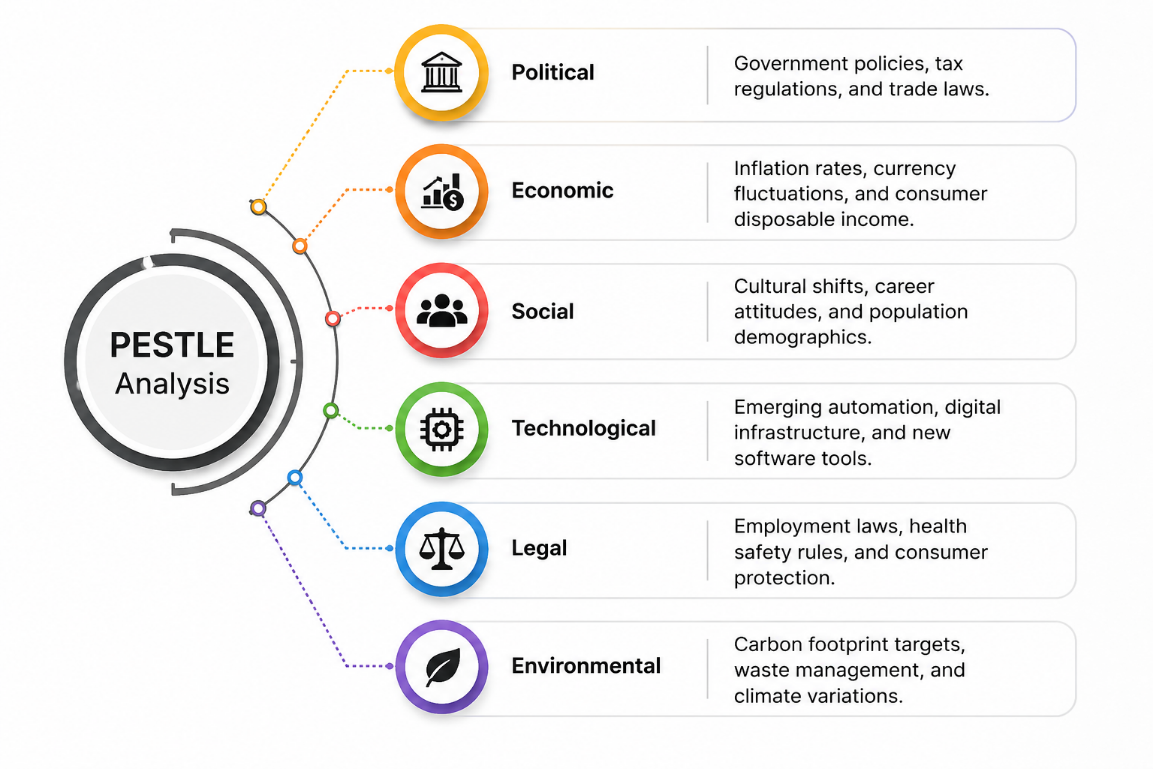
Practical Example
Let’s take an example of a new taxi app venture. The analyst conducts a PESTLE analysis to analyse the local transportation regulations and the city's internet connectivity speeds. Identifying technological trends in the region is extremely important. That is the reason why most students opt for a Business Analyst Course in Noida.
A use case is a document that shows the interaction of a user using a system and achieving a particular goal. Use cases help people understand how the software would be viewed from the perspective of a customer. You can experience it by joining a hands-on Business Analysis Course in Bangalore to practice with local startup projects.
Actors: These are the users or external systems that interact with the application.
System: This is the boundary of the application being analysed.
Goals: These are the results the users would like to accomplish.
A gap analysis is done to determine where the business stands now in relation to where it wants to be. It is based on asking two questions: “Where are we right now?” and “Where are we headed?” This process will enable managers to determine what they are lacking in their existing systems. Understanding how to conduct such an analysis forms one of the major foundations of a Business Analysis Course.
Current State: The existing performance of the business with the existing means.
Future State: The goals and capabilities the company would like to have.
The Gap: The process or upgrades required to close the gap between the current state and future state.
Analysts should never only see the visible issues but should delve deeper to identify the root cause. This method requires that one ask "why?" five times in succession until the root cause is discovered.
Real-World Workflow Example
Problem: The new app keeps crashing.
Why 1: There are too many data requests made to the server.
Why 2: Too many repeated queries are executed by the database.
Why 3: The code does not have any query cache processes in place.
Why 4: The software developer had to rush to meet the deadline.
Why 5: There is no optimised feature prioritisation process in place for the project.
Choosing your tool depends on your current project phase. Use this quick guide to choose the best framework.
|
Technique |
Primary Purpose |
Best Used For |
Typical Output |
|
SWOT |
High-level checks |
Project kickoff and start |
2x2 Matrix |
|
MoSCoW |
Task priority |
Sprint plans and scope |
Feature List |
|
PESTLE |
Outside risk checks |
Market entry and growth |
Risk Report |
|
Use Case |
App step mapping |
Tech build and software tests |
Flow Diagrams |
|
Gap Analysis |
Finding system flaws |
Change plans and strategy |
Checklist |
|
Root Cause |
Solving bad failures |
App fixes and code checks |
Why Tree |
How would these different methodologies integrate while working on a project within a corporation? Here is an example of the process followed by analysts:
Project Initiation: Perform a SWOT analysis as a justification for initial project investment.
Environmental Scan: Perform PESTLE analysis to determine compliance/legal risks.
Elicitation: Hold interviews with the stakeholders and obtain huge amounts of requirements for the project.
Prioritisation: Utilise the MoSCoW methodology to eliminate software functionality that does not really matter.
Modelling: Create clear use case diagrams that explain the workflow of the system.
Check: Review the final plans with managers to ensure success.
The resolution of issues related to data and software requires a strategic approach. Inclusion of SWOT, MoSCoW, PESTLE, Use Case, Gap Analysis, and Root Cause techniques into your toolkit will allow you to handle complex issues of the corporate world. The key to success is the correct application of the right tool. Practice applying them even to small daily activities.