Posted by Mike Sandlas
Filed in Business 4 views
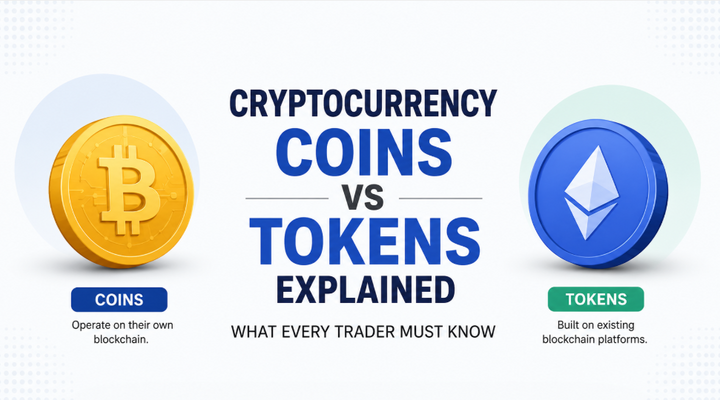
Most people use the words "coin" and "token" interchangeably. Most people are wrong and that mistake is quietly draining portfolios, distorting investment decisions, and creating dangerous blind spots for traders at every level. Whether you are a first-time buyer still figuring out how wallets work or a seasoned DeFi strategist managing a multi-chain portfolio, understanding the architectural difference between a cryptocurrency coin and a token is not just academic trivia. It is one of the most fundamentally important distinctions in the entire crypto ecosystem. The market has grown far too complex, and far too consequential, to navigate it with blurry definitions. As demand for blockchain-based finance continues to rise, businesses and developers are turning to crypto token development services to build customized digital assets that serve specific financial, governance, and utility purposes and traders who understand what those assets actually are will always hold an edge over those who do not.
A cryptocurrency coin is a digital asset that is native to its own independent blockchain. It exists as the foundational currency of that network, built directly into the protocol itself. Bitcoin is the most iconic example. It runs on the Bitcoin blockchain and has no existence anywhere else. Ether runs on Ethereum. BNB runs on BNB Chain. Solana's SOL runs on the Solana network. In each case, the coin is not just a unit of value. It is the lifeblood of the blockchain it belongs to. Without the coin, the network cannot function. Miners or validators are rewarded in that coin for processing transactions. Gas fees are paid in that coin. Security incentives are denominated in that coin.
What makes coins structurally distinct is their independence. They are not built on top of another blockchain. They do not rely on a host platform to define their rules or validate their existence. A coin has its own consensus mechanism whether that is proof of work, proof of stake, delegated proof of stake, or any other model and that mechanism is what gives the coin both its security and its legitimacy. The supply rules, the issuance schedule, and the transaction logic are all baked directly into the base protocol. This self-sufficiency is precisely why coins like Bitcoin carry the narrative of "digital gold." They are not products of anyone's smart contract. They are sovereign assets in the truest digital sense.
From a trading perspective, coins typically carry greater systemic importance than tokens. A collapse in a major coin's network has ripple effects across everything built on top of it. Traders who understand this treat coins and tokens with different risk frameworks and rightfully so.
A token, by contrast, is a digital asset that is created on top of an existing blockchain using a smart contract. Tokens do not have their own independent networks. They borrow the infrastructure of a host blockchain, most commonly Ethereum, and use it to define and enforce their own rules. When you see assets like USDT (Tether), LINK (Chainlink), UNI (Uniswap), or SHIB (Shiba Inu), you are looking at tokens, not coins. They exist because someone wrote a smart contract on Ethereum or Binance Smart Chain, or Solana, or Polygon and that contract defines how the token behaves, how much of it exists, and who can do what with it.
The most well-known standard for creating tokens on Ethereum is ERC-20, which allows developers to launch fungible tokens with a standardized set of rules. ERC-721 and ERC-1155 are standards used for non-fungible tokens, better known as NFTs. On BNB Chain, the equivalent is BEP-20. On Solana, the SPL token standard governs token creation. These standards are what make interoperability possible. Wallets, exchanges, and DeFi protocols can interact with any token that follows the standard without custom integration for each one.
Because tokens rely on the smart contracts of their host chain, they are inherently tied to the health and security of that chain. A vulnerability in Ethereum's consensus layer is a threat to every ERC-20 token. An upgrade or hard fork can affect how tokens behave. This dependency is something every trader needs to factor into their risk model. Tokens are powerful and flexible, but they carry a layer of infrastructure risk that native coins do not.
Not all tokens are created equal, and treating them as a monolithic category is one of the most common analytical mistakes traders make. Tokens can be broadly grouped into three major functional categories, each of which operates under different market dynamics and regulatory implications.
The first category is utility tokens. These are designed to give holders access to a specific product, service, or network function. Filecoin (FIL), for instance, is used to pay for decentralized storage on the Filecoin network. Basic Attention Token (BAT) is used within the Brave browser's advertising ecosystem. These tokens have intrinsic demand tied directly to usage of the platform they power. Their value is not purely speculative. It is connected to how much people actually use the service. For traders, utility tokens in growing ecosystems can represent genuine long-term value if adoption metrics are moving in the right direction.
The second category is governance tokens. These give holders voting rights over the future direction of a protocol. UNI (Uniswap) and AAVE are prominent examples. Governance tokens blur the line between investment and participation. Holders are not just betting on price. They are stakeholders with real influence over protocol upgrades, treasury allocations, and fee structures. As decentralized autonomous organizations (DAOs) have matured, governance tokens have taken on a more serious role in the DeFi ecosystem, and savvy traders analyze them with the same rigor as shareholders analyzing corporate equity.
The third and most explosive category is security tokens. These represent ownership of real-world assets such as equity in a company, shares of a real estate property, or claims on revenue streams. Security tokens are the bridge between traditional finance and blockchain, and they carry the heaviest regulatory scrutiny of any token type. In most jurisdictions, they are subject to securities law, which means issuers and sometimes traders need to comply with specific legal requirements. The tokenization of real-world assets is one of the most closely watched frontiers in institutional crypto adoption.
Building a cryptocurrency coin is a fundamentally different technical challenge than launching a token. Creating a native coin means creating an entirely new blockchain from scratch or forking an existing one. This involves designing a consensus mechanism, establishing a peer-to-peer network of nodes, writing a core protocol codebase, bootstrapping network security, and building an ecosystem of tooling that developers and users can actually work with. It is a monumental engineering undertaking. This is why the number of genuinely independent blockchain networks is relatively small compared to the number of tokens in existence. Litecoin is a fork of Bitcoin. Many smaller proof-of-stake chains are forks of Cosmos or Polkadot. Even Ethereum Classic exists because of a hard fork from Ethereum following the DAO hack in 2016.
The economic model of a coin is also defined at the protocol level. Bitcoin's 21 million hard cap is not a policy decision that can be changed by a company. It is written into the code, enforced by every node on the network. This kind of monetary immutability is one of the most compelling properties Bitcoin supporters cite when arguing for its long-term store of value narrative. Working with a reputable crypto coin development company is essential for any serious blockchain project because the architectural decisions made at launch, including consensus model, issuance schedule, block time, and fee structure, are extraordinarily difficult to change later without fracturing the community and the network.
Token creation, by comparison, is dramatically more accessible. A developer with a working knowledge of Solidity, Ethereum's smart contract programming language, can deploy a functioning ERC-20 token in a matter of hours. Token standards abstract away the hard infrastructure work and allow creators to focus entirely on defining the tokenomics and functionality of their asset. This accessibility is a double-edged sword. On one hand, it has unleashed an era of extraordinary financial experimentation, enabling DeFi protocols, NFT ecosystems, gaming economies, and social tokens to flourish. On the other hand, it has also enabled an enormous volume of scam tokens, exit schemes, and worthless meme coins to flood the market.
For traders, the barrier to token creation means that due diligence is non-negotiable. A token's smart contract should be audited by reputable security firms. The tokenomics need to be analyzed. What percentage of supply is held by the founding team, what is the vesting schedule, is there a burn mechanism, and what drives demand? A token backed by a genuine use case and transparent team is fundamentally different from one created purely for speculative pump cycles, even if both are technically ERC-20 tokens that look identical at the protocol level.
From a pure trading standpoint, the coin versus token distinction matters in several concrete ways. Liquidity profiles differ significantly. Major coins like Bitcoin and Ether have deep, mature liquidity across hundreds of exchanges and derivatives markets. Most tokens, even popular ones, have far thinner order books, which means slippage is higher and manipulation is easier. Traders operating in mid and small cap tokens need to account for this liquidity risk in their position sizing and exit strategy.
Custody and storage also work differently. Coins require wallets compatible with their specific native blockchain. Tokens, because they live on smart contracts, can often be stored in any wallet that supports the host chain. A single Ethereum wallet can hold thousands of different ERC-20 tokens simultaneously. This convenience is valuable, but it also means that a compromise of one wallet compromises everything on that chain at once.
Tax treatment is another area where the distinction matters, and it varies significantly by jurisdiction. Some regulators treat certain tokens as securities, which triggers a different tax and reporting framework than commodity-style coins. Traders operating at scale need to understand how their specific holdings are classified in their jurisdiction, particularly as regulatory clarity continues to evolve globally.
No discussion of coins and tokens is complete without examining the role of cryptocurrency exchanges, which serve as the primary gateway through which most traders access these assets. The infrastructure that exchanges provide, including matching engines, liquidity pools, custody services, and API connectivity, is what makes the entire market functional. As the lines between coins and tokens have blurred and as the number of tradable assets has grown into the tens of thousands, the demands placed on exchange infrastructure have become enormous. Projects that want to participate in this market and give their assets real trading exposure are increasingly turning to cryptocurrency exchange development services to build custom trading platforms that can handle the technical and regulatory complexity of listing both coins and tokens. Whether a project is building a centralized exchange, a decentralized AMM, or a hybrid platform, the architecture must be designed to handle the specific behaviors of the assets it lists and coins and tokens have meaningfully different technical requirements at the exchange layer.
The traders who consistently outperform the market are not necessarily the ones with the most capital or the fastest execution. They are the ones who understand the underlying structure of what they are buying. Knowing that a token lives on a smart contract means you know where to look for its vulnerability. Knowing that a coin's supply is capped at the protocol level means you understand its inflation mechanics without having to trust a company's promises. Knowing the difference between a governance token and a utility token means you can evaluate them with the right analytical framework rather than treating all crypto as a single undifferentiated asset class.
The market rewards precision. As institutional money continues to flow into the crypto space and as regulatory frameworks become more explicit around how different digital assets are classified, traders who have done the foundational work of understanding what they actually hold will be far better positioned to navigate the increasingly complex landscape ahead. The distinction between coins and tokens is not a technicality to be delegated to developers. It is a market fundamental and in 2025 and beyond, it is one that every serious trader needs to understand with the same clarity they bring to any other core element of their trading strategy.
The crypto market has never been more complex, more regulated, or more consequential than it is right now. Billions of dollars move daily across thousands of assets, most of which are tokens built on a handful of underlying blockchains. The traders who thrive in this environment are the ones who treat education as a competitive advantage. Understanding that a coin is a sovereign blockchain asset while a token is a smart contract-based instrument is not just a vocabulary distinction. It is a lens through which every risk assessment, every portfolio allocation, and every exit strategy becomes sharper and more defensible. Start there. Know what you own. And you will already be ahead of the majority of market participants who are still using the two words as if they mean the same thing.