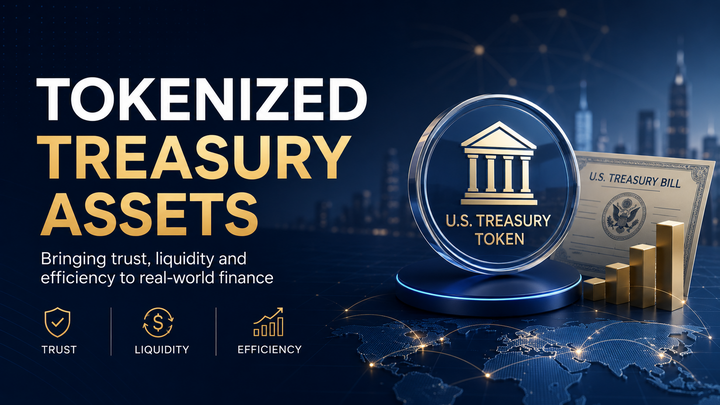
How Tokenized Treasury Assets Improve Liquidity in Government Bond Markets

Posted by suzie iris Thu at 3:00 AM

Filed in Arts & Culture 3 views

Government bond markets especially U.S. Treasuries are among the deepest and most important financial markets in the world. They serve as the global benchmark for risk-free returns, influence interest rates across economies, and act as core collateral in both traditional and digital financial systems. Despite their scale, these markets still face operational friction, settlement delays, fragmented trading hours, and intermediary-heavy infrastructure.

Tokenized treasury assets are emerging as a structural innovation that can improve liquidity, settlement efficiency, and market accessibility. By representing government bonds or treasury bills as blockchain-based digital tokens, these instruments become more transferable, divisible, and interoperable across financial ecosystems.

This transformation does not change the underlying credit quality of government debt. Instead, it modernizes how these assets are issued, traded, settled, and used as collateral.

Understanding Tokenized Treasury Assets

Tokenized treasury assets are digital representations of government-issued debt instruments recorded on a blockchain. These tokens correspond to ownership rights or claims on underlying treasury securities such as:

  • Treasury bills (T-bills)
  • Treasury notes
  • Treasury bonds
  • Short-term government securities

Each token is backed by real-world government debt held in custody by regulated institutions or custodians. The key innovation lies in digitization of ownership records and transfer mechanisms. Instead of relying solely on traditional clearing systems, tokenized treasuries can be transferred and settled through programmable blockchain networks.

Why Liquidity Matters in Government Bond Markets

Liquidity in bond markets refers to how easily securities can be bought or sold without significantly affecting their price.

Even though government bond markets are highly liquid compared to most asset classes, they still face structural limitations:

  • Settlement cycles can take T+1 or T+2 days
  • Trading is concentrated in specific market hours
  • Large transactions often require intermediaries
  • Repo markets involve complex collateral management
  • Cross-border access can be inefficient
  • Fragmentation exists between dealers and platforms

These factors create friction that slows down capital movement, especially in high-frequency institutional environments. Tokenization addresses many of these inefficiencies by redesigning settlement and transfer infrastructure.


1. Near-Instant Settlement Improves Market Turnover

One of the most significant liquidity improvements comes from faster settlement cycles. Traditional treasury transactions rely on centralized clearing systems that require multiple steps, including verification, reconciliation, and final settlement. This introduces delays between trade execution and final ownership transfer. Tokenized treasury systems enable near real-time settlement through blockchain-based transfer mechanisms.

This has several liquidity implications:

  • Capital is freed up faster for reinvestment
  • Counterparty risk is reduced
  • Trading cycles become more efficient
  • Market participants can execute more transactions in shorter timeframes

Faster settlement directly increases market turnover, which is a core driver of liquidity.


2. Fractional Ownership Expands Market Participation

Government bonds are typically large-scale instruments, which can limit participation from smaller investors. Tokenization enables fractionalization of treasury assets into smaller digital units, allowing:

  • Retail investors to access treasury exposure
  • Smaller institutions to participate in bond markets
  • Fintech platforms to offer micro-investment products
  • Broader diversification across fixed-income assets

By lowering entry barriers, tokenized treasuries increase the number of market participants, which naturally enhances liquidity. More participants mean more buyers and sellers, leading to tighter spreads and improved price discovery.


3. 24/7 Trading Capability Enhances Market Efficiency

Traditional treasury markets operate within fixed trading hours, primarily aligned with institutional market schedules. Tokenized treasury assets, being blockchain-based, can operate on 24/7 trading infrastructure depending on platform design and regulatory permissions.

This introduces:

  • Continuous price discovery
  • Reduced reliance on market opening hours
  • Faster reaction to macroeconomic events
  • Increased global accessibility across time zones

Continuous trading environments typically improve liquidity by eliminating downtime and allowing markets to adjust dynamically.


4. Improved Collateral Mobility in Repo Markets

Treasuries play a critical role as collateral in repo (repurchase agreement) markets, which are essential for short-term funding in global finance.

However, traditional collateral management involves:

  • Manual reconciliation
  • Settlement delays
  • Fragmented custody systems
  • Operational inefficiencies in substitution and rehypothecation

Tokenized treasury assets improve collateral mobility by enabling:

  • Instant collateral transfer
  • Automated margin adjustments
  • Real-time verification of ownership
  • Programmable repo agreements through smart contracts

This increases the velocity of collateral usage, which enhances overall market liquidity.


5. Reduced Intermediary Dependence Lowers Friction

Traditional bond markets rely heavily on intermediaries such as brokers, clearing houses, custodians, and settlement agents. While these entities ensure stability and compliance, they also introduce layers of cost and delay. Tokenized systems reduce dependency on multiple intermediaries by embedding rules directly into blockchain infrastructure.

Benefits include:

  • Lower transaction costs
  • Faster execution workflows
  • Simplified settlement chains
  • Reduced operational bottlenecks

Lower friction increases trading frequency, which improves liquidity conditions.


6. Enhanced Transparency Improves Price Discovery

Liquidity is closely linked to transparency. When market participants can clearly observe ownership, transaction history, and asset flows, price discovery becomes more efficient.

Blockchain-based treasury tokens provide:

  • Immutable transaction records
  • Real-time ownership tracking
  • Transparent settlement status
  • Verifiable audit trails

This reduces information asymmetry, allowing participants to price assets more accurately. Improved price discovery typically leads to tighter bid-ask spreads and higher liquidity.


7. Cross-Border Accessibility Expands Investor Base

Traditional government bond markets often face geographic and regulatory barriers that limit participation from international investors.

Tokenized treasury assets can be distributed through digital platforms that enable:

  • Broader global access (subject to compliance rules)
  • Simplified cross-border settlement
  • Reduced currency and custody complexity
  • Easier participation for institutional investors in multiple jurisdictions

Expanding the investor base increases demand-side liquidity, particularly during periods of macroeconomic uncertainty when treasuries are in high demand.


8. Integration with DeFi Liquidity Systems

One of the most transformative aspects of tokenized treasuries is their potential integration with decentralized finance (DeFi) ecosystems.

Tokenized government bonds can be used as:

  • Collateral in lending protocols
  • Yield-generating stable assets
  • Liquidity pool components
  • Risk-free benchmark instruments in DeFi markets

This integration introduces additional liquidity channels outside traditional financial systems.

It also allows capital to flow more efficiently between traditional and digital markets, increasing overall market depth.

9. Automated Market Making and Secondary Trading

Tokenized treasury platforms can integrate automated market makers (AMMs) or digital order books that facilitate continuous trading.

This enables:

  • Always-available liquidity pools
  • Automated pricing mechanisms
  • Reduced reliance on dealer networks
  • Faster matching of buyers and sellers

In traditional bond markets, liquidity is often concentrated among large institutional dealers. Tokenization democratizes liquidity provision by allowing algorithmic and decentralized participation.

10. Improved Capital Efficiency for Institutional Investors

Institutional investors often hold large treasury positions as part of liquidity management strategies.

Tokenization improves capital efficiency by enabling:

  • Faster reallocation of treasury holdings
  • Real-time collateral optimization
  • Automated yield strategies across platforms
  • Reduced idle capital due to settlement delays

More efficient capital usage translates directly into higher liquidity across the system.

Broader Impact on Global Financial Markets

The tokenization of treasury assets has implications beyond government bond markets. It influences:

  • Benchmark interest rate formation
  • Stable collateral frameworks for financial systems
  • Liquidity provisioning across asset classes
  • Integration of traditional and digital financial infrastructure

Because treasuries serve as foundational instruments in global finance, improvements in their liquidity can have cascading effects across credit markets, derivatives, and digital asset ecosystems.

Challenges to Full-Scale Adoption

Despite strong potential, several challenges remain:

Regulatory alignment

Different jurisdictions are still developing frameworks for tokenized securities and digital settlement systems.

Market infrastructure integration

Legacy clearing systems must be adapted to interact with blockchain-based settlement layers.

Liquidity fragmentation risk

Multiple tokenization platforms could initially fragment liquidity before standardization emerges.

Institutional adoption cycles

Large financial institutions typically require long testing and compliance cycles before full integration.

Future Outlook for Tokenized Treasury Markets

In the coming years, tokenized treasury assets are likely to become a foundational component of digital financial infrastructure. Expected developments include:

  • Institutional-grade tokenized government bond funds
  • Integration with central bank digital currency (CBDC) systems
  • Expansion of real-time settlement networks
  • Unified collateral systems across traditional and digital markets
  • Standardized global tokenization frameworks for sovereign debt

As adoption grows, liquidity improvements will become more structural rather than experimental, reshaping how government bond markets operate at scale


Conclusion

Tokenized treasury assets improve liquidity in government bond markets by reducing settlement time, expanding investor participation, enabling continuous trading, enhancing collateral mobility, and improving transparency. These changes collectively increase market efficiency and capital flow velocity.

While traditional treasury markets are already highly liquid by conventional standards, tokenization introduces a new layer of operational efficiency that can further optimize how these assets are traded and utilized across global financial systems. As infrastructure matures and regulatory frameworks evolve, tokenized government bonds are likely to play a central role in bridging traditional finance with blockchain-based capital markets, creating a more connected, efficient, and liquid global financial ecosystem.

 
click to rate