Posted by Abdul Samad
Filed in Other 23 views
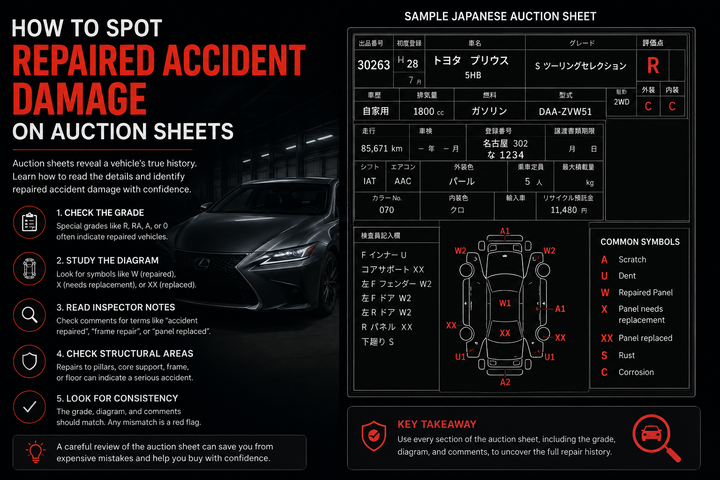
Purchasing vehicles through Japanese auctions has become one of the most trusted methods for sourcing quality imported cars at competitive prices. Buyers around the world rely on Japanese auction cars because they offer transparency, professional inspections, and detailed vehicle histories. Despite these advantages, many buyers overlook one of the most important aspects of the purchasing process: identifying repaired accident damage.
A vehicle may appear immaculate in photographs, yet its auction sheet could reveal a history of repairs that significantly impacts its value and long-term reliability. Understanding how to read auction sheets correctly can help buyers avoid costly mistakes and make more informed purchasing decisions.
An auction sheet is a comprehensive inspection report prepared by a qualified auction inspector before the vehicle enters the auction lane. It provides an unbiased assessment of the vehicle's overall condition and highlights any defects, repairs, or concerns.
Unlike private sellers who may omit important information, Japanese auction houses document a vehicle's condition in detail. This level of transparency is one of the reasons why Japanese auction cars remain highly sought after worldwide.
However, the value of an auction sheet depends entirely on the buyer's ability to interpret the information correctly.
The overall auction grade is often the first clue regarding a vehicle's repair history. While grading systems vary slightly between auction houses, most follow a similar structure.
Vehicles with grades between 4 and 5 are generally considered to be in good condition with minimal wear and no significant accident history. Grades below 4 require closer examination because they may indicate cosmetic damage, repairs, or heavy use.
Special grades deserve particular attention:
R Grade
RA Grade
A Grade
0 Grade
These grades often indicate that a vehicle has been repaired following an accident or has undergone restoration work. While this does not automatically mean the vehicle is a poor purchase, it should encourage further investigation.
One of the most valuable sections of an auction sheet is the vehicle condition diagram. This illustration contains symbols that identify defects and repairs across different parts of the vehicle.
Common symbols include:
A = Scratch
U = Dent
W = Repaired panel
X = Panel requires replacement
XX = Panel already replaced
S = Rust
C = Corrosion
Among these markings, the "W" symbol is particularly important because it indicates that repairs have already been carried out. Multiple W markings on different panels can suggest previous collision damage.
Buyers evaluating Japanese auction cars should carefully review both the number and location of these symbols.
Not every repaired panel should be viewed as a major concern. Minor incidents can result in repairs to doors, bumpers, or fenders without affecting the vehicle's structural integrity.
However, certain repaired areas deserve closer scrutiny.
These include:
Roof panels
Rear quarter panels
Front pillars
Rear pillars
Core supports
Cross members
Damage or repairs in these areas often indicate a more serious accident history than simple cosmetic repairs.
Understanding which repairs are structural and which are cosmetic can dramatically improve the quality of purchasing decisions.
The inspector's remarks section frequently contains information that is not immediately visible elsewhere on the auction sheet.
Look carefully for references such as:
Frame repair
Chassis correction
Core support replacement
Rear panel repair
Floor repair
Pillar repair
These components form the structural foundation of the vehicle. Repairs involving these areas may indicate that the car experienced a significant collision in the past.
A structurally repaired vehicle is not necessarily unsafe, but buyers should understand exactly what repairs were performed and whether the work was completed to a high standard.
The comments section is often the most revealing part of an auction sheet. Experienced inspectors use this area to record observations that cannot be fully represented through grades and symbols alone.
Comments may include phrases such as:
Accident repaired
Front impact repaired
Rear impact repaired
Welded repair
Support replaced
Frame corrected
Because these notes are typically written in Japanese, international buyers often struggle to interpret them accurately.
This is where a dependable Japanese auction sheet translator tool becomes extremely valuable. Accurate translations allow buyers to uncover critical details that could otherwise remain hidden.
A useful strategy when reviewing auction sheets is to compare all available information for consistency.
For example, a vehicle with a high auction grade but numerous repair markings may warrant further investigation. Similarly, an R-grade vehicle with very few visible repair indicators could require additional verification.
The auction grade, damage diagram, and inspector comments should generally support one another. Significant discrepancies should be treated as warning signs.
Not every repaired vehicle should be avoided. Japan is known for exceptionally high repair standards, and many restored vehicles continue to provide years of reliable service.
Positive indicators include:
Limited structural repair notes
Good panel alignment
Consistent paint quality
Detailed inspection comments
Strong auction grades after repair
When repairs have been carried out professionally, Japanese auction cars can offer excellent value while remaining dependable transportation options.
Certain combinations of findings should immediately raise concerns.
Watch for:
Multiple structural repairs
Extensive welding references
Frame correction history
Numerous replaced panels
Poor auction grades combined with accident records
Missing or unclear inspection notes
These issues do not automatically make a vehicle unsuitable, but they do justify additional caution and professional evaluation.
As international demand for Japanese vehicles continues to grow, buyers increasingly depend on digital translation solutions to understand auction reports.
A reliable Japanese auction sheet translator tool can translate technical terminology, inspector comments, and repair descriptions into clear English. This enables buyers to evaluate vehicles more accurately and make decisions based on facts rather than assumptions.
Translation tools are most effective when combined with expert advice, auction experience, and careful inspection of vehicle photographs.
Auction sheets provide a remarkable level of transparency, but only for buyers who know how to interpret the information correctly. Understanding repair symbols, structural repair notes, replacement indicators, and inspector comments can reveal a vehicle's true history before any bid is placed.
For anyone considering Japanese auction cars, learning how to identify repaired accident damage is an essential skill. By carefully reviewing auction grades, studying vehicle diagrams, and utilizing a trusted Japanese auction sheet translator tool, buyers can minimize risk and purchase vehicles with greater confidence.
For buyers seeking dependable auction vehicles and professional guidance throughout the import process, Nobuko Japan helps customers navigate Japanese auctions with confidence, providing access to quality vehicles and the information needed to make informed purchasing decisions.