Posted by Jackson Gabriel
Filed in Business 21 views
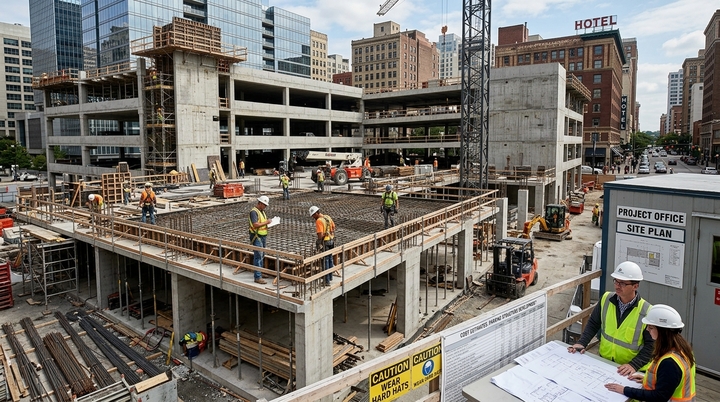
Constructing a parking structure in the U.S. is a significant commitment not only financially but also for residents, businesses, and towns alike. On the whole, multi-story parking garages tend to set back the developer anywhere between $25, 000 and $50, 000 for every parking spot. However, things get really costly with either underground or automated parking facilities. Actually, knowing what influences these costs is the first step to budgeting and planning the right way.
Parking garages accommodate vehicles, but they also serve as major infrastructural developments for neighborhoods, malls, campuses, hospitals, etc. Efficiently designed parking facilities help solve parking problems, offer secure and easy access, and indirectly raise property values in the neighborhood. Local governments as well as businesses can benefit from knowing the exact construction costs to avoid any financial shortfalls during the course of the project.
During the initial phase of such an undertaking, several planners turn to construction estimating companies for accurate calculation of expenses, taking into account labor rates, materials, and local factors so that a parking structure is deemed viable economically before the commencement of construction.
In the US, particularly, the determining factor for how much the building of a parking structure would cost is what kind of facility it is. Generally speaking, there are a few types:
These types make up the most basic and the cheapest method of parking. They would be perfect for the likes of suburban communities, schools, and small commercial establishments where land doesn't pose a problem. A go-to figure for a standard surface lot would be about $3, 000 to $10, 000 per parking spot, depending on factors such as grading, paving material quality, and site development. Last but not least, surface lots lend themselves well to speedy construction as they hardly need any support structures.
Above-ground garages are, by far, the most popular type of parking facilities in cities. They can be from two to ten stories tall, and their structure can be precast or cast-in-place concrete. Usually, the total building cost is somewhere between $15, 000 and $35, 000 per parking space, but the choice of materials and elaborate architectural details can make the cost a lot higher.
Of all the types, underground garages are the most prohibitively expensive parking structures. Excavation, sealing against water, and structural strengthening are the main reasons why one parking space may run from $30, 000 to $50, 000. However, these spaces are scarce only on the surface, so underground garages provide you with the maximum amount of usable land in highly populated cities.
Automated or mechanical parking garages are very advanced technologically. They allow you to double or triple your parking space while the footprint remains unchanged. The cost of these systems varies from $40, 000 to $65, 000 per space; however, efficiency, convenience, and high-tech features make them highly desirable elements of modern urban developments and shopping malls, in particular.
First and foremost, factors determining the cost of parking garages include:
Precast concrete is one of the most economical building materials, and installation is quicker compared to cast-in-place. On the other hand, with cast-in-place, you have more room for your creativity, and you can also come up with more attractive architectural designs. Depending on the design, steel and hybrid materials might also be options.
Labor costs differ widely throughout the USA. New York, San Francisco, and Chicago usually have higher labor costs than the suburban or rural locations. Besides, engaging local contractors who know the municipal codes inside out will have an effect not only on the cost but also on the project timeline.
The site topography, soil quality, and water table are the main determinants of cost. Uneven ground or soil of poor quality may require more grading, pilings, or foundation. Underground garages are very sensitive to site conditions because excavation costs go up quickly.
The level of the design also affects cost. For example, curved ramps and decorative facades of architectural elements as well as lighting and security systems, all increase the construction cost. Parking structures that are designed to blend with surrounding buildings often require additional engineering and materials.
The cost of design fees, engineering, permits, and project management when combined is usually 20-30% of the total project cost. Early planning by using estimating services enables communities to make soft cost estimates as well.
To better understand parking structure expenses, consider the following approximate costs per parking space:
|
Structure Type |
Typical Cost per Space |
Notes |
|
Surface Lot |
$3,000 – $10,000 |
Quick to construct; limited vertical space |
|
Precast Concrete Garage |
$25,000 – $35,000 |
Durable, fast installation |
|
Cast-in-Place Concrete Garage |
$30,000 – $45,000 |
Flexible design, slower build |
|
Automated Parking |
$40,000 – $65,000 |
Space-efficient, high-tech |
|
Underground Garage |
$30,000 – $50,000+ |
Excavation and waterproofing required |
While this table outlines a budgetary framework quite effectively, local differences and the nature of projects inevitably present a degree of variation from the costs shown here.
Carrying out a detailed commercial takeoff is not just a good idea but a must before initiating a construction project. This involves systematically measuring the material quantities, estimating labor needs, and pricing the construction overall. When done correctly, the budgets will closely mirror actual costs rather than being simply ballpark figures.
Besides, detailed planning gives an opportunity for the community and businesses to find ways of lowering costs, e.g., through precast concrete or modular designs, without losing safety and functionality.
Due to factors like scarcity of land, tightening of regulations, and greater wages for the labor force, the cost of construction in cities is usually on the higher side. On the other hand, suburban or even rural areas that face very low costs of land and labor potentially may be required to bring in additional facilities such as lighting, drainage, landscaping among others.
Along with additions to design complexity and construction costs, environmental regulations, management of stormwater, and meeting the requirements of accessibility (ADA standards) have to be considered. Good planning is the key to making sure all these requirements are met while keeping the extra costs to a minimum.
Things that happen after the construction phase is done, such as cleaning, repairs, and inspections, should be kept in mind when preparing the budget. Choosing long-lasting materials and protective paints can be very helpful in lowering these kinds of expenses over time.
Besides being a financial commitment, parking structures also offer numerous perks to the American communities, such as:
Help in decongesting roads by offering a dedicated parking area.
Help local merchants by making it easier for customers to get to them.
Make cities more pleasant to the eye through attractive architectural designs.
Offer a source of income through ticketed parking systems in commercial locations.
Building a parking structure in the USA requires a significant amount of attention, skills, resources, and a good financial plan. Different aspects of a parking project, such as the type of structure, materials, labor, site conditions, and the complexity of design, affect the overall cost. Planning by consulting with estimating services, including 1800 Estimating for structural steel, and getting the project details down on paper helps communities and businesses to prepare more accurately, lower the risk of financial loss, and realize a useful, durable parking solution.
By learning the factors that affect costs, choosing the most suitable type of structure, and planning carefully, U.S. neighborhoods can build parking facilities that are not only economically and practically viable but also promote local development and accessibility.
Typically, multi-story parking garages cost between $25, 000 and $50, 000 per space, depending on the design, location, and other factors.
Absolutely. The price of underground garages usually crosses $50, 000 per space because of excavation, structural, and waterproofing requirements.
Surface parking facilities are usually the cheapest, ranging from $3, 000 to $10, 000 per parking space.
Engaging U.S. estimating services and doing a takeoff will help you prepare an accurate budget based on site conditions and architectural design.
Yes, indeed. Soft costs can increase the total expenses of a construction project by about 20-30%, and hence they must be considered right from the start.